Sunday, January 31, 2021

How to answer hard job interview questions


These are tough – here are tips to prepare and feel confident.

Job interviews are nerve-wracking and these common questions don’t make it any easier. In fact, they’re downright dreaded, based on feedback from your fellow job seekers.

While employers and hiring managers can be encouraged to tweak these questions to have more thoughtful conversations with you, it’s still in your best interest to learn how to answer them, in case they come up.

When you’re asked, “Why do you want this job?”

The obvious answer is “to pay bills” or “make more money” - but you should aim for a more thoughtful response. When you apply for the job, or you’re preparing for the interview, make note of what about sounds appealing about the job duties or a description that stuck out to you. Something prompted you to apply, right? Even if it’s as simple as how the job description perfectly matched your experience and is closer to family/with a company you like/in a new industry, you can find something to promote. Plus, interviewers are typically interested in what motivates you and what you’re looking for in a team or from a role, so frame your answer to meet those expectations.

The famed, “What’s your biggest weakness?”

Hopefully by now you know that a stealth-brag is not the way to go. For years, it was acceptable to offer something like “I’m a perfectionist” or “I take on too much work” but hiring managers have caught on. Typically, your potential employer is looking more for your level of self-awareness and how you address any issues that arise. Offer how you’ve worked to improve your skills in an area or prioritized professional development. Everyone has to learn new things on a regular basis to remain on top of their jobs – were you a pro at creative thinking and strategy but lacked formal data analysis? Share how you recognized that weakness and took action to improve.

“Where do you see yourself in five years?” - which can be unclear even in the best of times

This is tricky. Employers often want to gauge how serious you might be about this role, your commitment to the industry or how you might fit into longer term company plans. But maybe this is your first job (ever or in your field), or you know that in five years, you’d like to be living in a new city, start a business or spend more time with family. Regardless, you don’t have to give away your personal life plan. Demonstrate your dedication by highlighting how you’ve earned certificates or praise, courses you’ve taken, promotions you’ve received, and share how you’d like to continue learning and growing in your next role.

Any form of “What’s your spirit animal?” “Describe in detail how to make a PB&J sandwich.”

Some companies still deploy off-the-wall tactics in interviews, usually to test how you think on your feet, solve problems and deal with unexpected situations. Since you can’t prepare for any exact answers, you can think through what makes you unique and understand how you solve problems. As part of your job interview practice, consider your problem-solving style and how you find solutions in the moment. When you’re presented with any of these scenarios, you’ll be equipped to navigate them.

Monday, January 25, 2021

6 fastest-growing jobs last year


The skills you need and training required to get hired.

We won’t spend too much time describing the impact of the coronavirus pandemic on employment – 2020 was a tough year full of rollercoasters and you can check out our job seeker support center here.

Keep reading for a look at three of the fastest-growing job titles from last year that held steady even in the worst unemployment months and are relatively attainable.

Plus, we're highlighting three more roles that might have been less visible throughout the year but likely grew as a result of pandemic-response needs.

Which jobs stayed steady during the pandemic?

Insurance clerks

Processing claims, reviewing and creating policies, maintaining coverage – these were all essential to navigating 2020. From in-depth analyses of insurance needs to communicating with stakeholders, this job requires a breadth of skills. Your duties in this role would encompass document processing and preparing, computer-based work, receiving and processing information, and communicating heavily with your coworkers and with customers.

What experience do you need to be an insurance clerk? Most jobs typically require a high school diploma and at least a year or so of working with the public or in similar roles, based on industry research. Helpful soft skills include attention to detail, dependability and composure – you might be helping your customers work through difficult times or understand complicated policy, and being patient and understanding will go a long way.

What is the pay for an insurance clerk? The national average is $51,000 per year. This can vary based on location and education – see more about insurance clerk salaries here.

What roles are similar to an insurance clerk? Check out receptionist jobssecretary jobs and administrative assistant jobs.

Financial analysts

Another vital part of the response to the pandemic included workers who could track and report on what was happening with the U.S. economy, along with providing insight on how to make it through a tough year. Financial analysts were crucial in 2020 and job growth reflected that importance.

On the job, this role involves collecting, studying and monitoring financial data to maintain and improve financial success. You might compare real-time financial results against goals, plans and forecasts, requiring analytical and mathematical skills. Other skills could include organization and collaboration.

What experience do you need to be a financial analyst? A bachelor’s degree is often required, as well as a demonstrated ability to analyze data.

What is the pay for a financial analyst? The national average is $89,000 – learn more about financial analyst salaries here.

What roles are similar to a financial analyst? Budget analyst jobsplanning analyst jobs and accounting analyst jobs

Real estate brokers

These workers helped navigate the almost-overnight shift to remote and socially distanced work as offices and businesses adapted to the pandemic. And as more people worked from home and for longer, many started to search for bigger homes or move to less crowded cities. Your daily job duties might look like negotiating deals, finding and listing properties for sale, managing real estate offices, and of course, selling homes, businesses and other real estate.

What do you need to be a real estate broker? According to the Bureau of Labor Statistics, 37% of real estate brokers have bachelor’s degrees, and usually you need similar experience and additional certifications in the real estate industry. Knowledge in sales and marketing is helpful, along with good writing and verbal skills. Critical thinking and active listening are great soft skills to utilize in this role.

What is the pay for a real estate broker? National average salary is $80,000 – see what you might make as a real estate broker in your area.

What roles are similar to a real estate broker? Real estate agent jobsproperty manager jobs and loan officers

3 more jobs that grew in 2020

Floor sanders and finishers. This role is critical to completing construction projects and polishing real estate to be sold. A high school diploma is typically needed, and the median wages in 2019 were $39,610 per year. Learn more about the job here, and apply to construction jobs here.

Solar sales rep. The “green economy” continues to grow, including the installation of technology like solar panels. According to the Bureau of Labor Statistics, in this role you would “Contact new or existing customers to determine their solar equipment needs, suggest systems or equipment, or estimate costs.” About 73% of the workers in this job have a bachelor’s degree or some college, some related experience is usually required and the median wages in 2019 were $81,020 per year. Great verbal and written communication skills are important, along with active listening, critical thinking and persuasion skills. Knowledge of sales and marketing, plus technology and design, can contribute to success in this job. Apply to solar sales rep jobs here.

Air traffic controller. Personal travel might be down, but the shipping and transportation industries received major boosts due to pandemic needs. The workers part of the teams making this happen? Air traffic controllers. This role has a variety of career paths, but at the heart of it, you direct air travel and traffic to get planes, people and goods to the right place. Skills in use in this role include judgment and decision making, complex problem-solving, and an understanding of when or how an issue might arise. The national average salary for an air traffic controller is $87,000. Apply to air traffic controller jobs here.


Wednesday, November 25, 2020

The benefits to look for in this new remote world of work


AS WORK ENVIRONMENTS CHANGE, YOU MIGHT WANT TO CONSIDER A NEW PERSPECTIVE ON YOUR BENEFITS AND PERKS.

The company you work for can make a big impact in helping you and your coworkers feel confident in navigating a crisis (say, a pandemic). From traditional benefits to office perks and company culture, things will continue to look different as more than 20% of the working population does so from home.

As work environments change, think about what you need with a new perspective.

When it comes to classic benefits, compare or consider:

  • Health care and related support. Make sure any healthcare plans offered align with your typical and ongoing needs but ask your potential employer if the company has made changes since to these policies in response to the pandemic. Are they now covering more of the premium than before, has mental health support been added or are there other new benefits to help employees take care of themselves and stay healthy?
  • Paid time off, parental leave and flexibility in hours. If you’re working where you’re living, you still need time off to decompress and recharge. How does this company expect you to be “on” during your work hours? Is there flexibility to pick up kids from daycare or run an errand during the day when stores are less crowded?
  • Hazard pay and safety measures. Maybe you’re not fully work-from-home, and you have to travel onsite to support clients, receive inventory or any other duty that requires an in-person appearance. Related: transportation accounts. Pre-pandemic, a company might have covered your parking garage fees or allowed you to contribute to a commuter account before taxes. Ask if hazard pay and/or transportation perks are available and the safety measures the company is taking to protect employees right now.

Now, the perks of a job. Office dwellers could usually depend on a selection of “extras” that improved cubicle culture, from snacks to happy hours or activities. When considering a remote position, there are two important questions to ask yourself or the hiring manager:

Was the process easy? Job hunting won’t ever be as easy as essentially signing-up for a gig, but companies, especially now, should be making an effort to have a streamlined and seamless hiring process start-to-finish. This shows this employer wants applicants to feel part of the team from the beginning, as well as demonstrating this team cares about your experience.

How does the company try to replicate or replace in-person interaction? From Zoom hangouts and companywide meetings and events, to recognition on internal platforms, check if your potential future employer is investing in its culture. Connection to your coworkers is important for productivity and team success.

How does the company make sure you feel part of the team? Family, pets and roommates are now common guests in meetings, as are grocery deliveries and loungewear. How often these work from home quirks appear can say a lot about your potential employer. Maybe childcare is a benefit you’d like, or, maybe the company proactively communicates that it’s no problem for kids to be part of your daily professional life. Inclusivity is important, and that comes from both benefits and culture.

Monday, November 9, 2020

How a focus on skills can expand your career

INSIGHT INTO WHY DEVELOPMENT AND TRAINING ARE CRUCIAL FOR SUCCESS.

In an effort to share the stories of the CareerBuilder employees who are hard at work #BuildingForYou, we continue our employee feature series, from celebrating individuality and lending personal experience to their insight on industry trends and everything in between.  

Anna Pena joined the CareerBuilder team a little more than two years ago and has since grown with the company and improved her skills while advancing products. Through her work as the Senior Release Manager for our global Product Teams, Anna touches every part of product development and has learned much along the way. Read on to learn about her favorite project at CareerBuilder and how her dad inspired her career choices. 

How have you grown professionally during your time at CareerBuilder? 

I have had fantastic opportunities to expand my skill set at CareerBuilder, starting with certifications in the scaled agile framework and release training engineering. I can reinforce and apply the learnings from the certifications directly into day-to-day work. The certifications and experience gained at CareerBuilder allowed me to move from focusing solely on release readiness activities to facilitating Research &Development/IT planning.

What do you enjoy most about working at CareerBuilder? 

The best part about working at CareerBuilder is hands down the people. CareerBuilder is stacked with dedicated, smart people who are self-motivated to get the work done. There have been countless times when team members step up to help hit a deadline and still manage to have fun doing it.  

What is your favorite project that you have worked on during your time at CareerBuilder?

Facilitating and participating in the CareerBuilder beta program has, by far, been my favorite project. Being part of a process where we engage our internal experts in test driving new features and products before release has been rewarding. CareerBuilder is full of very passionate and knowledgeable employees who know the industry and our client needs exceptionally well, so getting their feedback before launch has been very beneficial.

What is the best career advice you’ve ever received? 

Get out of your comfort zone! Becoming an expert in something is great, but you cannot stop learning and challenging yourself. The majority of the time, taking on something new (even if it is hard at first) is where you grow, so don’t be afraid to raise your hand for a unique opportunity. 

What was your first job, and what were your biggest takeaways from the experience? 

I had a paper route delivery with my sister when I was 12. I learned very early on what it means to commit to a job; if you commit to something, you need to follow through with it even when it is raining outside and you have papers to deliver! 

What inspired you to choose your current career path? 

Seeing my dad work his way up to managing a major manufacturing facility was an inspiration to get into some facet of the business world. He made it look easy when it wasn’t, and I got to see firsthand how a good leader can set up teams for success. Watching his career progress showed us where hard work and a career you're passionate about can lead.

Monday, October 26, 2020

The best career advice: just go for it


Employee feature Emma Iglesias header

HOW ONE CAREERBUILDER TEAM MEMBER TOOK INSPIRATION FROM PEERS AND LEADERS TO SHAPE HER PATH.

In an effort to share the stories of the CareerBuilder employees who are hard at work #BuildingForYou, we continue our employee feature series, from celebrating individuality and lending personal experience to their insight on industry trends and everything in between.

Since joining the team in 2019, Emma has been an invaluable asset to the CareerBuilder marketing team. From establishing lead generation processes to navigating our B2B pandemic response, she has led many team members through every challenge along the way. Continue reading to learn more about Emma's work at CareerBuilder - and what she learned from working behind a deli counter.

How have you grown professionally during your time at CareerBuilder?

When I joined CareerBuilder, I helped build up the demand generation marketing team from ground zero. Contributing to this new function allowed me to work with multiple teams across the organization and taught me how a business operates, while providing me with the necessary vantage point to aid in breaking down silos.
While I started at CareerBuilder as an individual contributor, I now manage a team of five direct reports and oversee our e-commerce channel. While I can attribute a lot of that to my hard work and dedication, I wouldn’t have been able to get to this place without the support and mentorship of the leaders I’ve worked with along the way.

What do you enjoy most about working at CareerBuilder?

What I enjoy most about working at CareerBuilder is being part of a group of strong, powerful and uplifting women. I’ve learned so much from my direct and indirect leaders about business, professionalism, and being a great leader. Even better, they’ve taken the time to nurture my potential and maintain patience while I learn my way around new responsibilities.

What is your favorite project that you have worked on during your time at CareerBuilder?

One of the most challenging, yet rewarding, moments in my career occurred in the first few weeks of the COVID-19 pandemic. As the world went into shut-down, CareerBuilder had a huge mountain to climb to get past the increasing unemployment rate and jobs decrease. The way the entire business came together in support of our response to the pandemic was inspiring and a huge testament to what people can do when they come together.

It was not only an honor to contribute to CareerBuilder’s response but a fantastic learning experience for myself. During this time, my business acumen, presentation skills, and leadership skills improved ten-fold.

What is the best career advice you’ve ever received?

Be vocal about what you want and prove it. While this wasn’t necessarily direct advice from one person, it is something that I have learned through my career from my own experiences, as well as from my peers. It’s easy to get overlooked for opportunities when you’re not vocal about wanting them. It’s also not enough to say you want it; you also prove that you can do it because, after all, “actions speak louder than words.”

What was your first job, and what were your biggest takeaways from the experience?

My first job was behind the deli counter of a Mariano’s. While working there, I learned a lot about my work ethic and uncovered my passion for driving efficiencies through process improvements. I specifically recall a time when I typed a two-page letter to my manager, kindly suggesting improvements to the night- and morning-shift responsibilities that would allow us to save time and money.

Who inspires you and why?

I’ve always been inspired by people who choose to have a positive spirit despite the hardships in their lives. It’s a testament to being grateful for the small things that life gives us, which is something to always strive to achieve.

Where is your favorite place in the world?

There’s this eco-park in Playa Del Carmen, Mexico called Xcaret; it is where I go to in my mind when people say, “go to your happy place.” Experiencing a trip around the park’s lazy river is literally like heaven as it weaves in and out of caves, forest, and large “cenotes” or sinkholes. I’ve been thinking about this place a lot during the pandemic.


Monday, October 5, 2020

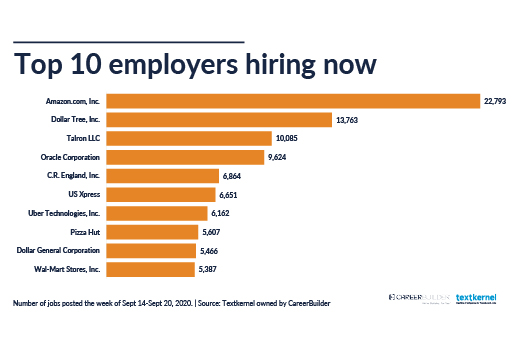
Jobs available this week as food and retail stores increase hiring


EVERY WEEK, CAREERBUILDER SHARES REAL-TIME HIRING DATA TO PROVIDE INSIGHT INTO THE CURRENT EMPLOYMENT LANDSCAPE.

CareerBuilder job insights

Find a job near you and in companies and industries that are hiring right now.

The coronavirus pandemic is far from over, including its impact on employment. Keep up to date with who’s hiring each week, and make sure your resume is uploaded to the CareerBuilder job board to get in front of thousands of employers.

Companies hiring now

These 10 companies are hiring for more than 92,000 jobs. They include:

  1. Jobs at Amazon
  2. Jobs at Dollar Tree
  3. Jobs at C.R. England
  4. Jobs at Pizza Hut

Top job openings

These roles continue to grow, week after week. Build a resume in minutes and use the CareerBuilder salary tool to check out what these positions pay.

  1. Truck driver jobs
  2. Registered nurse jobs
  3. Retail sales jobs
  4. Retail supervisor jobs
  5. Software developer jobs
  6. Customer service rep jobs
  7. Stock clerk jobs
  8. Food service supervisor jobs

Industries that are hiring

The top 10 industries that are hiring right now include:

  1. Administrative jobs
  2. Waste management jobs
  3. Retail industry jobs
  4. Healthcare industry jobs
  5. Transportation industry jobs
  6. Warehouse jobs
  7. Manufacturing jobs
  8. Food service industry jobs
  9. Finance industry jobs
  10. Insurance jobs

Sunday, July 5, 2020

Companies hiring this week

CareerBuilder Hiring Data Series


CareerBuilder job insights


Find a job near you and in companies and industries that are hiring right now.

Companies with available jobs
The top five include Crete Carrier, US Xpress, Marten Transport, Hunt Transportation and Drive LLC. Search by employer and industry at careerbuilder
Industries that are hiring
Transportation jobs and warehouse positions are still widely available as part of the response to the coronavirus pandemic, making sure shelves stay stocked and goods are delivered. Look for administrative and support roles, and healthcare, professional and technical services are all in high-demand.


Multiplex