Friday, June 26, 2020

6 tips for landing a summer job


Summer hiring

IF YOU WANT TO LAND A GOOD JOB, FOLLOW THESE TIPS TO MAKE THE RIGHT KIND OF IMPRESSION WITH EMPLOYERS.

If you’re in the market for a summer job, your prospects are looking hot. According to a new CareerBuilder survey, 41 percent of employers plan to hire seasonal workers for the summer. The vast majority (88 percent) expect to transition some summer hires into permanent roles, up from 79 percent last year.
Even better news? These summer jobs will pay well, too. The majority of employers hiring this summer (87 percent) plan to pay $10 or more per hour on average, 56 percent expect to pay $12 or more per hour and 25 percent plan to pay $15 or more per hour. Considering the federal minimum wage is $7.25, a majority of these jobs will pay well over minimum wage.
Who are companies looking to hire?According to the survey, employers are targeting both younger and more mature workers to fill their summertime roles. Nearly 3 in 4 (73 percent) say they plan to recruit college students, 39 percent say high school students and 26 percent say retirees. Two in five employers hiring for the summer are looking to hire veterans for their summer positions.
What positions are companies hiring for?When you think summer job, you probably think lifeguard, camp counselor or something related to the outdoors. Yet, many positions are available in (air-conditioned) stores or corporate settings. Areas where employers are hiring include customer service (25 percent), warehouse (25 percent), office support (25 percent) and retail (18 percent).
Advice for your seasonal job searchWhile summer workers may be in demand, you can’t just slack on your job search. If you want to land a good job – and potentially make it permanent – you’ll need to follow these tips to make the right kind of impression with employers.
1. Apply ASAP. Employers have already started recruiting for summer positions, so now is the time to submit your applications. While it’s important to customize your application materials as much as possible, tools such as CareerBuilder’s Quick Apply All let you apply to multiple similar positions simultaneously, saving you time and getting you closer to landing your summer job.
2. Take the opportunity seriously. While movies may depict summer jobs as a temporary gig where you can put in the minimum amount of effort, if you want to get your foot in the door at an organization, you need to take the job seriously. Treat it as you would any full-time role by thoroughly researching the position and company, preparing for interviews and following up to show your interest. And let the hiring manager know up front if you’d like a permanent role down the line – it will help you stand out as a candidate.
3. Be flexible. If you’re up for working any shift, you’ll up your chances of getting hired, and you’ll make your manager happy once you’re on the job. Also, be willing to take on responsibilities that may not have been in the original job description – by showing you’ll go above and beyond, you’ll prove you’re worth keeping around.
4. Dress appropriately. You may be tempted to wear more casual attire when interviewing for a summer job, but it’s important to dress for the role and the company, not for the season in which the job is offered. Check out this handy guide for what to wear to different types of job interviews.
5. Apply for the right reasons. When searching for summer jobs, don’t just apply for the ones with the best employee discounts. Seek out jobs that will be a stepping stone on your career path. Speaking of employee discounts – don’t ask about them during the interview; that’s a surefire way to leave a bad impression.
6. Show you’re excited. Sure, the summer gig may not be your dream job, but you should still act like it is during the interview and once you’re on the job. A little enthusiasm can go a long way especially when employers are assessing whether you can provide good service to internal or external customers.

Wednesday, June 24, 2020

Companies hiring this week

EVERY WEEK, CAREERBUILDER SHARES REAL-TIME HIRING DATA TO PROVIDE INSIGHT INTO THE CORONAVIRUS EMPLOYMENT LANDSCAPE.

CareerBuilder job insights

Find a job near you and in companies and industries that are hiring right now.
What companies are hiring now?
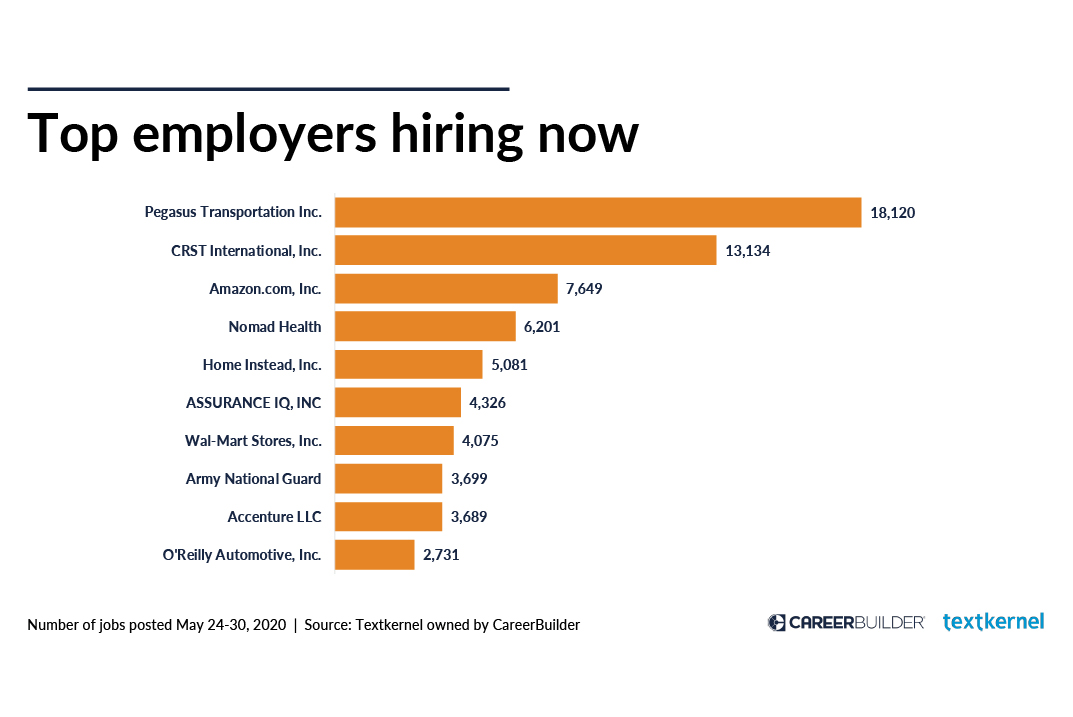
Thousands of jobs are available at CRST International, Pegasus Transportation, Amazon, Wal-Mart, and Home Instead, among others.
What jobs are available?
The top five in-demand positions include truck driversregistered nursessoftware developerscustomer service reps and retail associates.
What industries are hiring?
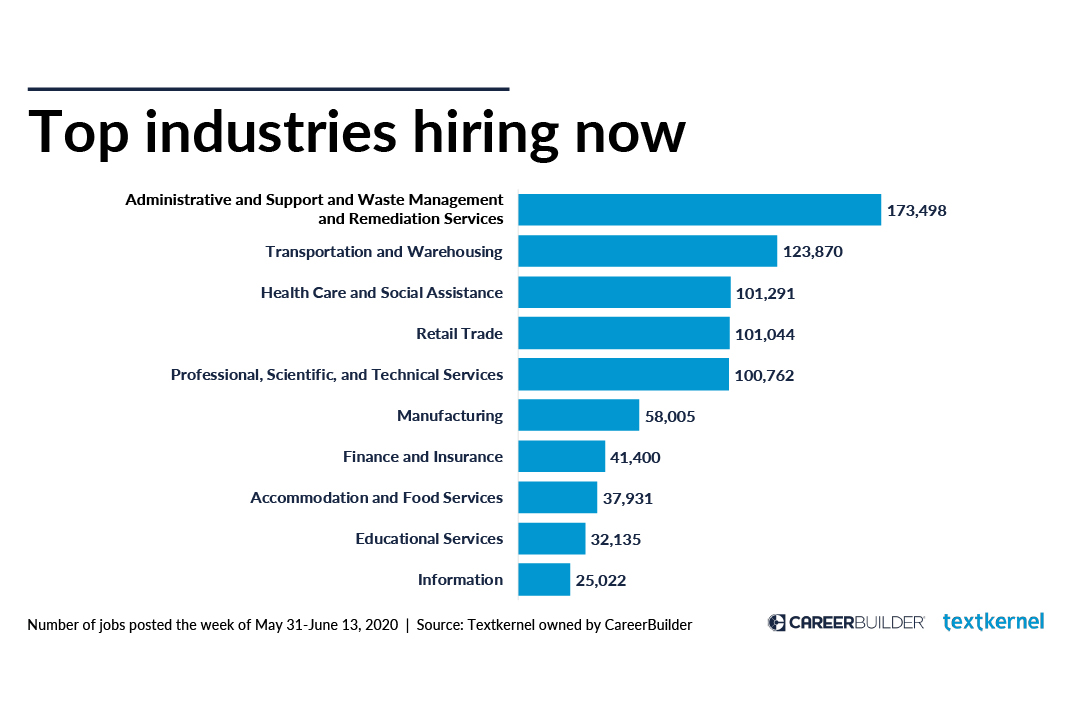
There are thousands of open positions in a variety of support services industries, as well as transportation, warehousing, healthcare, social assistance, retail and manufacturing.

Thursday, June 11, 2020

Tips to find a job after college and during a recession


Tips for recent college graduates from 2008 grads

THREE CAREERBUILDER EMPLOYEES WHO GRADUATED COLLEGE IN 2008 SHARE ADVICE FOR RECENT GRADS

The COVID-19 pandemic has left many college graduates nervous about what the future has in store for them. Their fears may be similar to those of college graduates who were entering the workforce during the Great Recession in 2008.
We pulled together some CareerBuilder employees who lived through that time and asked them to share their experience and offer advice to this year's graduating class. We sat down with Jessica Ribish (Marketing Automation Manager), Brandi Frattini (Talent Acquisition Team Lead) and Timothy Kincade (Senior Account Executive) to hear about how they stayed positive, worked towards their professional goals and advice they have for the next generation entering the workforce.
What were your initial thoughts as you graduated college and during your initial job hunt?
Jess: When I graduated college, I felt a mix of emotions: scared, uncertain and excited. The economy wasn’t great, I didn’t know if there would be a job out there for me, and I had $700 monthly college loan payments to start making on top of paying the rent of my first apartment. Yet, at the same time, I was looking forward to my post-college life, and I couldn’t wait to see where it took me.
Brandi: Even when there isn’t a recession, almost all new grads have challenges looking for employment in their field of study. Knowing this, I remained committed to my job search and looked for roles that provided me with experience in the field of HR, even if the location or pay was not ideal.
Tim: Fortunately, I had a job lined up, so I didn’t panic or get discouraged after graduating like many others. When I graduated, I was a bank teller and shortly later took on another job as a sales associate with a gym. This helped me gain invaluable experience that helped me continue building a resume within sales.
Did you have to pivot your career ambitions to find a job? What advice do you have for expectant college grads who are now looking for a job?
Jess: Yes, I was a double major in Graphic Design and Marketing, cum laude and honors graduate – so I thought I would apply to the first few design and marketing roles I saw and have job offers just lining up out the door. Entry-level positions weren’t available when I was looking, and every position required at least 3-5 years of experience. Understanding that I needed to get some real-world experience, I applied for a sales role. During my interview process, I asked about lateral movements within the company since marketing was really my passion and the hiring manager said that if I worked hard and met my sales goals consistently that those types of moves could be possible. I took the job, put everything I had into it, survived a layoff, gained a massive amount of B2B knowledge, and earned a role in marketing two years later.
Brandi: I doubled down on making sure I got as much experience in HR as I could. Naturally when you finish college you are hoping for a paid job or internship, I didn’t have that kind of luck. I took unpaid internships, I volunteered my extra time with HR associations, and dealt with long commutes to get the experience I wanted.
Tim: While I had a job lined up, I still had to pivot. Originally, I was planning to move to Atlanta and start my professional career there, but I decided to stay local and take some additional courses. This was ultimately the best decision for me, because after spending a few years working within sales in Chicago I was able to make the move to Atlanta in 2011.
What advice do you have for this group of college grads?
Jess: Now is not the time to be picky. If the exact position you want isn’t available right now, try to find a company you like, whose values align with yours, within an industry you care about or find interesting. I have no doubt that you have transferable skills that would be relevant for an opening they have now. Although the position may not be your ideal at the moment, take it as an opportunity to learn, work hard, gain experience in new areas, and make strong connections with people – all of that will help you for years to come as your career path takes new twists and turns. One more piece of advice, start investing in your 401k now!
Brandi: Be flexible and patient! All the activities, side jobs and volunteer opportunities you are doing during this time are building your resume and giving you experience to speak to at your next interview. Take this time to build your network and online brand.
Tim: Always have a backup plan. If you don’t have one, make sure you utilize the tools and resources to help you (i.e. career center at your school, academic advisor). Do not panic, this is not the end of the world - you will get through it. Technology sales is very popular, and companies are always hiring recent grads with no or minimum sales experience. A large percentage of employees in that profession do not have degrees in business related fields. It’s a great way to work in an amazing environment and earn a good living while you’re still pursuing your dream.

Friday, June 5, 2020

Companies that are hiring and in these locations (June 3)


COVID-19 Data by CareerBuilder

EVERY WEEK, CAREERBUILDER SHARES REAL-TIME HIRING DATA TO PROVIDE INSIGHT INTO THE CORONAVIRUS EMPLOYMENT LANDSCAPE.

CareerBuilder job insights

Find a job near you and in companies and industries that are hiring right now. Utilize careerbuilder.com/salary to learn what you should be earning, at what job title and in your city.
What companies are hiring and where?
The top employers with open jobs include Pegasus Transportation, CRST International, Amazon, Nomad Health and Home Instead, among others. Click here to find a job at Amazon.

And almost every state in the U.S. is seeing positive job growth. Use location filters to find a job near you on careerbuilder.com/jobs.
Top jobs available
Insurance sales agents:
267% increase in jobs posted
National average salary of $90,500
Hairdressers, hair stylists and cosmetologists:
109% increase in jobs posted
National salary of $46,000
Top industries that are hiring
The finance industry and insurance industry have remained relatively stable throughout the pandemic, and with most businesses starting to slowly re-open, hiring in these industries is on the rise. Transportation and warehousing continue to be top industries for finding employment. Find a transportation job here or apply to available warehouse positions.

Monday, June 1, 2020

The job search tools you need to land your next role


Tools for your job hunt

THE BACK-TO-BASICS APPROACH FOR WHEREVER YOU ARE IN YOUR PROCESS

The job market is tough right now. Many companies and industries are still hiring – either as essential services or as businesses start to re-open – but millions of people are still out of work, and competition for roles is increasing.
Are you searching for a job for the first time? Or were you laid off or furloughed and haven’t looked for a new job in years?
Go back-to-basics with these essential job hunt tools and strategies.
Optimize key words in your resume
Your resume should map back to a job description – either to the exact one you’re applying for or to others listed in your field. As companies are flooded with resumes and relying on technology to sort and find matches, your resume will need to stand out from the rest. Focus on what makes you unique, then incorporate key words from job descriptions. These should be accurate and highlight your skills, experiences or internships. Build a resume in minutes using AI-powered keywords.
Build and expand your network through job boards
Connect with thousands of employers that are actively looking to hire by uploading your resume and applying to roles through a job board. Whether an internal recruiter at a company reaches out to learn more about you, or you nab an interview for a specific role, your presence on a job board can become your own personal network. This is a smart move for all professionals, but especially entry-level and early-career workers who might not have the same personal connections as someone who’s been working for years.
And what if a company you’re interested in doesn’t have any open roles that match your skills or experience? Still apply. Or sign up to receive alerts about jobs. That company is constantly building a pipeline of interested, qualified candidates, and you’ll be on the list when a new role opens.
Work with a recruiter
Where job boards expand your search, staffing firms and placement agencies can supplement with a targeted approach. Many firms and agencies are industry-specific, from advertising creatives to tech professionals to logistics. Plus, as businesses weather economic uncertainty, there is an increased interest in using agencies to fill contract or short-term positions. Take advantage of these opportunities to gain on-the-job experience while bringing in a paycheck.
Practice your interviewing skills
Once your resume and skills get you to the next round in the process (congrats!), prepare to make a real connection with your potential new employer. Utilize your friends, family and others in your network to get comfortable talking about your skills, prior experience and why you are a strong candidate to fill the role. Practice your virtual interviewing skills and make sure your technology works prior to the interview.
It's easier said than done but – be patient
Even if your dream position is not available at the moment, look for any sort of opportunity to gain real-world experience and build transferable skills in industries and roles that are hiring. From temporary gigs to volunteer work or internships, keep making connections and adding skills to your resume.


Thursday, May 28, 2020

The transition from a military to civilian career just got easier

CareerBuilder and Google Military Partnership

HELPING VETERANS FIND THE RIGHT JOBS.

An estimated 250,000 U.S. military members enter civilian life each year. These brave men and women possess an array of leadership and business skills that make them a valuable asset to any civilian organization. Despite their potential to succeed in the civilian workforce, many struggle with making the transition.
Being a veteran myself, I know firsthand how difficult this transition can be. When it comes to finding a job, where do you even begin? How do you translate what you’ve done during your years of service into skills and experience that would resonate with civilian employers?
The good news is many employers recognize the value military veterans can bring to an organization and are eager to recruit them.
Knowing that employers are ready and willing to hire military veterans, the men and women transitioning from active duty need the right resources to help them match their skills with available opportunities.
Tech tools to find veteran-friendly jobs
One of the obstacles ex-military personnel face when job searching is understanding how to find civilian job equivalents to the roles they held in the military. That’s why CareerBuilder supports Google Cloud’s job search feature, which enables transitioning service members to find relevant civilian jobs available right now on CareerBuilder.com and our clients’ talent networks.
Using the Google Cloud Talent Solution feature, U.S. military service members can enter their military occupational specialty code (MOS, AFSC, NEC) on CareerBuilder and find relevant civilian jobs that require similar skills to those used in their military roles. (You can also include rank codes, for example, 11A for Infantry Officer or 11B for Infrantryman.)
Utilize online veteran communities
CareerBuilder and RallyPoint, one of the largest military-focused online networks in the world, formed a partnership designed to help veterans quickly connect with top employers who want to actively recruit them to work for their companies. CareerBuilder powers RallyPoint’s job board, connecting RallyPoint’s 1.5 million military members to their network of thousands of employers.
Transitioning service members often rely on sites such as Military Times for unbiased news and information affecting their military and civilian lives. Their career site hosts a wide range of jobs across industries from employers actively looking to hire veterans, and comprehensive tools for service members and veterans to use in their job search.
Top skills veterans should highlight on their resume
In addition to functional skills and accomplishments, veterans, especially those who feel underemployed or are in low-paying jobs, should highlight their soft skills when marketing themselves to employers. In particular, employers say they look for these skills that members of the armed forces typically bring to organizations after leaving active duty:
  • Ability to work as a team
  • Disciplined work approach
  • Respect and integrity
  • Perform under pressure
  • Leadership skills
  • Industries hiring veterans
    Employers say veterans are being recruited across a wide variety of functions, including:
  • Customer service
  • Information technology
  • Production
  • Sales
  • Accounting/finance
  • Employers see the tremendous value in hiring transitioning military personnel and veterans – and these service men and women are just as eager to start their civilian careers. With the right resources and tools to help employers connect with veterans and veterans find the right jobs for their unique backgrounds, we’ll move closer toward the goal of having all veterans gainfully employed in meaningful post-military careers.

    Tuesday, May 26, 2020

    How to find a job when unemployment is high

    Expert advice for finding a job in high unemployment

    HERE ARE 6 WAYS TO HELP COMBAT A COMPETITIVE JOB MARKET.


    Just three months ago, candidates had their pick of who to work for, sometimes even “ghosting” after accepting a job offer. There were more open roles than candidates available for work, and the unemployment rate sat at record lows for months.
    Now, with the COVID-19 pandemic turning our economy and social lives upside down, it can be tough to sort out what will help, what won’t and what you can actually control. It’s unsettling to see a 14.7% unemployment rate and hear about friends, family, and neighbors losing jobs.
    But real-time data is showing positive signs, with week-over-week job losses starting to decrease and stabilize, and industries like construction, manufacturing, and retailare increasing job posts. There is still high demand for front-line response industries like transportation and warehousing – supporting huge retailers like CVS, Amazon and Home Depot – and non-critical care healthcare positions are also on the rise.
    As you look for a job in this more competitive hiring landscape, here are a few tips to set yourself apart and find your next role, fast.
    Upskill and highlight transferable skills
    If your desired industry isn’t in high-demandidentify and leverageskills that can translate into a new profession. In some cases, economic downturns provide opportunity for continued education and development. Spend time taking online classes and trainings to upskill and strengthen your resume. 
    Look for part-time and contract labor positions
    While positions and long-term opportunities may be limited, look for work in high-demand industries inthat may be more short-term. This will allow you to add to or build on your skills while bringing home a paycheck.
    Make sure your resume is competitive and up to date
    Crafting a resume that best highlights skills and other achievements is important for any job seeker. Utilize tools like AI to build a personalized, job-specific resume. You’ll want to showcase your achievements in a concise, ATS-approved way.
    Utilize a job board
    When uploading and applying for positions on a job board, your resume can then be accessed by thousands of companies looking to source candidates and build their talent pipeline. This will also allow you to learn about roles that match your skill set and interests as they become available.
    Clean up your social media
    It’s important you don’t have anything that could turn off a hiring manager, like tasteless content or complaints about a former job or boss. In a CareerBuilder study, we found 70% of employers use social networking sites to research job candidates, and of those that do, 57% have found content that caused them not to hire candidates. If used wisely, social media can help you stand out and show skills or interests that don’t fit on a resume, especially when 43% of employers said candidates’ social media content influenced their decision to hire them. Make sure your online presence puts your best foot forward.
    Nurture your network
    Build and leverage your connections to make sure you are getting in front of the right people for roles that are open right now. Companies will often find new candidates through referrals, so job seekers should ask their networks in case anyone they know can introduce them to relevant hiring managers.

    Multiplex